

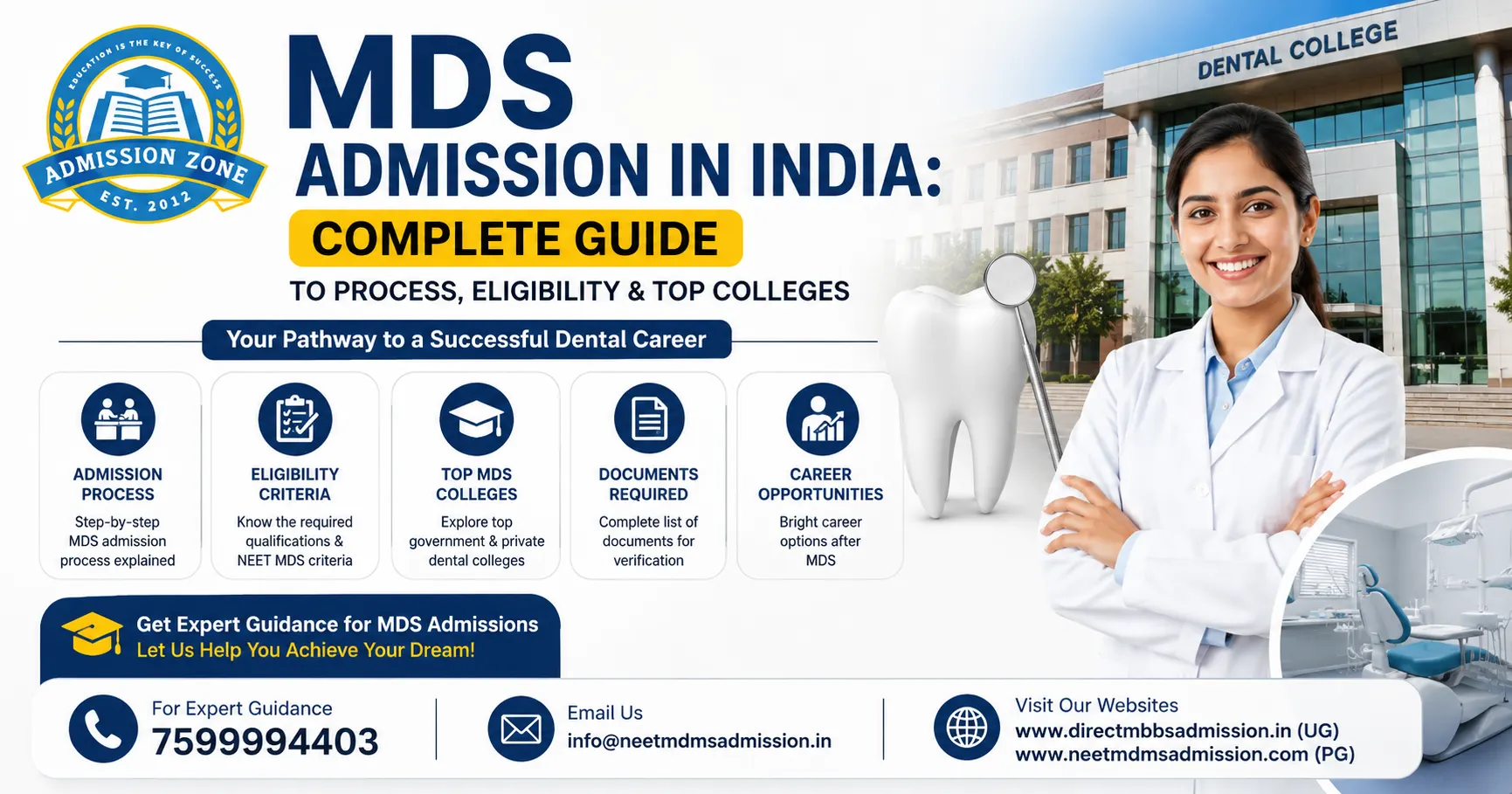
MDS Admission in India is the admission process for postgraduate dental (MDS) courses through the National Eligibility cum Entrance Test for MDS. Candidates with a BDS degree and completed internship are eligible. The process includes qualifying NEET MDS, registering for counselling, filling choices, seat allotment, document verification and final admission.
What is MDS Admission in India
MDS admission is the process through which BDS graduates secure postgraduate dental specialisation seats in recognised dental colleges. Admission is based on the NEET MDS entrance exam conducted by NBEMS. A candidate’s rank, category, domicile, and applicable quota determine eligibility for admission, college allocation and the MDS specialisation offered.
What is an MDS Course
MDS (Master of Dental Surgery) is a postgraduate dental specialisation program pursued after BDS. It provides advanced training in specialities like Oral Surgery, Orthodontics, and Periodontics through academic study, clinical practice, research and patient care. Graduates become qualified dental specialists, eligible for independent practice, teaching, and research careers.
MDS Course Duration in India
The MDS course duration in India is 3 years for all recognised dental specialisations in government and private colleges. The curriculum includes academic training, clinical practice, research and dissertation work. Students gradually progress from supervised learning to independent patient care ending with final university examinations and a viva voce.
NEET MDS 2026: Eligibility Criteria
This is the section most aspirants search for directly, so here’s the exact eligibility breakdown for NEET MDS 2026.
Educational Qualification: You must hold a Bachelor of Dental Surgery (BDS) degree from a college or university recognized under the MDS Course Regulations, with approval from the Ministry of Health and Family Welfare.
Registration: You need to be registered – either provisionally or permanently – with a State Dental Council or the Dental Council of India.
Internship Completion: A mandatory 12-month compulsory rotatory internship must be completed by the cut-off date notified in the official NEET MDS information bulletin (typically set around late May or June of the exam year).
Age Limit: There is no upper age limit for NEET MDS. Some sources note a minimum age requirement of 20 years, effectively met by anyone who has already completed BDS and internship.
Number of Attempts: There’s no cap on how many times you can attempt NEET MDS. As long as you meet the eligibility conditions, you can appear every year until you secure the seat you want.
Nationality: Indian citizens, Overseas Citizens of India (OCIs), and Persons of Indian Origin (PIOs) are eligible to apply. NRI candidates fall under a separate quota, discussed further below.
A word of caution: even a small gap – like a pending internship certificate or incomplete registration – can disqualify an otherwise strong candidate at the counselling stage. Always cross-check your documents against the current year’s official information bulletin released by NBEMS before applying.
How to Get Admission to MDS in India
There isn’t a single, one-size-fits-all path into an MDS seat. Depending on the type of college and quota, candidates go through one or more of these routes:
- NEET MDS (All India Route): The single national-level test that qualifies you for both All India Quota and most state/private/deemed seats. This is mandatory for anyone seeking MDS admission anywhere in India.
- State Counselling: After qualifying NEET MDS, candidates from a particular state can also register for that state’s own counselling process for state quota and private college seats within that state.
- Deemed University Counselling: Deemed universities often conduct their own centralized counselling (sometimes through a common consortium), but eligibility is still based on the NEET MDS score.
- Management and NRI Quota: Separate, direct-entry routes within private and deemed colleges, discussed in detail below.
Government vs Private MDS Admission
The choice between a government and a private dental college affects nearly everything – from fees to clinical exposure to the type of seat you’re competing for.
Government College Admission: Seats are filled almost entirely through merit – your NEET MDS rank, category, and choice-filling during counselling. Fees are heavily subsidized, often just a few thousand rupees per year, but competition for these limited seats is intense.
Private College Admission: Private dental colleges also require a valid NEET MDS score, but seats are typically split in quota categories – state quota, management quota and NRI quota – each with a different fee structure. Merit still matters, but a lower rank can still secure a seat through a management or NRI quota that a government college wouldn’t offer.
In both cases, participation in either MCC counselling (for the All India Quota) or the relevant state counselling authority is mandatory – there’s no way to bypass the exam and counselling process, even for private seats.
Management and NRI Quota Explained
Private and deemed dental colleges typically divide their seats into a few distinct categories:
- Government/State Quota Seats: Filled through state counselling based on NEET MDS rank, usually at more affordable fees compared to management seats.
- Management Quota Seats: Allotted directly by the college’s own management, though the candidate must still hold a valid, qualifying NEET MDS score. Fees here are considerably higher than state quota seats.
- NRI Quota Seats: Reserved for candidates whose sponsor (usually a close relative) is a Non-Resident Indian. This route requires additional documentation, including a sponsorship affidavit and proof of the sponsor’s NRI status, and carries the highest fee bracket among all quota types.
If you’re considering a management or NRI quota seat, it’s worth directly verifying the college’s quota-wise fee structure and eligibility conditions on its official website, since these vary significantly from one institution to another.
MDS Course Fees in India
BDS course fees vary widely in institutes, from affordable government colleges to premium private universities. Students should compare tuition structures and quotas before selecting the right dental college for admission.
| College Category | Estimated Fee Range (Total Course) |
|---|---|
| Central Institutes (AIIMS, JIPMER) | ₹6,000 – ₹50,000 |
| State Government Dental Colleges | ₹50,000 – ₹3.5 Lakhs |
| Private Dental Colleges (State Quota) | ₹9 Lakhs – ₹18 Lakhs |
| Private Dental Colleges (Management Quota) | ₹18 Lakhs – ₹36 Lakhs |
| Deemed Universities & NRI Quotas | ₹30 Lakhs – ₹60+ Lakhs |
Top MDS Colleges in India
India has well over 300 dental colleges offering MDS programs across specialisations. Some of the most consistently well-regarded institutions Known for clinical training, faculty strength and infrastructure, include:
- Maulana Azad Institute of Dental Sciences, New Delhi
- Government Dental College and Hospital, Mumbai
- Manipal College of Dental Sciences, Manipal
- SDM College of Dental Sciences, Dharwad
- Christian Dental College, Ludhiana
- Government Dental College, Nagpur
- Sri Ramachandra Dental College, Chennai
When shortlisting colleges, don’t rely on rankings alone – check the college’s specialisation-wise patient inflow, faculty-to-student ratio and recognition status with the National Medical Commission’s Dental Council before finalising your choices during counselling.
MDS Specializations
There are nine recognised MDS specialisations in India, each a three-year program:
- Oral and Maxillofacial Surgery
- Orthodontics and Dentofacial Orthopaedics
- Prosthodontics and Crown & Bridge
- Periodontology
- Conservative Dentistry and Endodontics
- Oral Medicine and Radiology
- Oral Pathology and Microbiology
- Pedodontics and Preventive Dentistry
- Public Health Dentistry
Specialisations like Orthodontics, Oral & Maxillofacial Surgery, and Prosthodontics tend to be the most competitive, both for seats and in terms of career and private practice earning potential. Public Health Dentistry and non-clinical branches usually have comparatively lower cut-offs and fees.
MDS Admission Schedule 2026
While exact dates shift each year slightly, the general MDS admission cycle follows this sequence:-
- NEET MDS Notification and Registration – The application window generally opens in the early months of the year.
- Exam Date – The computer-based test is usually conducted in spring.
- Result Declaration – Scorecards are released a few weeks after the exam.
- Counselling Registration – Conducted by MCC for All India Quota seats and by respective state authorities for state quota seats.
- Choice Filling and Locking – Candidates rank their preferred colleges and specialisations.
- Seat Allotment (Multiple Rounds) – Provisional results are followed by final allotment across several counselling rounds.
- Reporting and Admission – Candidates report to their allotted college with original documents for verification and fee payment.
Because counselling schedules can be delayed or revised, it’s essential to track official announcements from NBEMS (nbe.edu.in), and MCC (mcc.nic.in) directly rather than relying on projected dates alone.
Documents Required for MDS Admission
Keep these ready well before counselling begins, since even a missing document can cost you a seat during verification:-
- NEET MDS admit card and scorecard/rank letter
- BDS degree certificate or provisional passing certificate
- Compulsory rotatory internship completion certificate
- State Dental Council or DCI registration certificate
- Class 10 and Class 12 certificates (for date-of-birth proof)
- A valid photo ID (Aadhaar, PAN, passport, or driving license)
- Passport-size photographs (as specified in the counselling notice)
- Category certificate – SC/ST/OBC/EWS/PwD – if applicable
- For NRI quota: passport copy, sponsorship affidavit and proof of the sponsor’s NRI/relationship status
Carry both originals and photocopies to every counselling and reporting stage – most colleges will not accept photocopies alone for admission verification.
Why Choose Admission Zone
- The Admission Zone helps students get proper guidance for medical admissions.
- We guide students for admission to good medical colleges
- We provide honest counselling
- We help students understand the admission process
- We help students with NRI and Management quota fees negotiation
- No hidden charges and full transparency
- Trusted guidance with years of experience
Connect with Us
Need guidance for MDS, MD/MS, or NEET PG counselling? The Admission Zone expert team is here to help. Call us at 9205488482 / 7599994403 or connect with us on WhatsApp for personalized admission guidance and counselling support.