

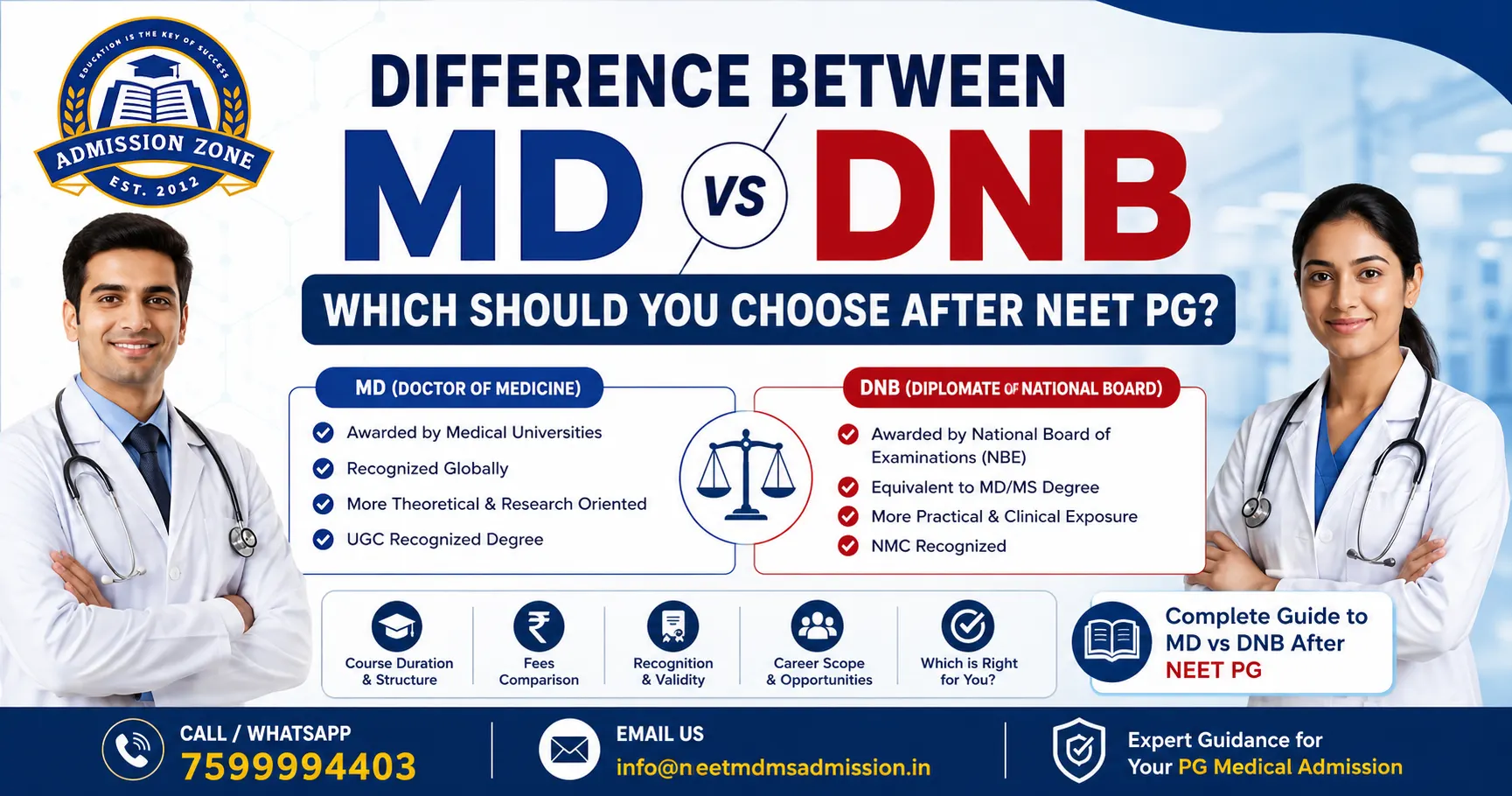
Every NEET PG qualifier eventually asks the same question: MD vs DNB, which is better? Both are postgraduate medical qualifications, both need NEET PG for entry, and both are recognised by the National Medical Commission (NMC) yet the training model, exam pattern, and long-term career fit are genuinely different.
Here’s a clear and fact-based breakdown of the difference between MD and DNB covering recognition, NMC rules, hospital vs college training, salary, difficulty, fees, and scope so you can choose based on what actually suits your career, not just the label.
Quick Answer
MD is a postgraduate medical degree awarded by universities, while DNB is awarded by NBEMS through accredited hospitals. Both are recognised by the NMC and offer specialist career opportunities. The main differences are training environment, examination pattern, and teaching eligibility. Your choice depends on career goals, clinical exposure, and institute quality.
RANK PREDICTOR
Select Your Category
Enter Your NEET PG Score
Almost There!
DNB Full Form and What DNB Medicine Means
DNB stands for Diplomate of National Board, a postgraduate medical qualification awarded by the National Board of Examinations in Medical Sciences (NBEMS), an autonomous body under the Ministry of Health and Family Welfare. MD (Doctor of Medicine) is instead awarded by universities through NMC-affiliated medical colleges. In everyday use, “DNB in medical” refers to this NBEMS-run alternative pathway to the same specialist status as MD/MS.
| Particulars | MD | DNB |
|---|---|---|
| Awarding Body | University (NMC-affiliated medical college) | National Board of Examinations in Medical Sciences (NBEMS) |
| Training Setting | Government/private medical colleges | Accredited hospitals – government, private, corporate, and mission hospitals |
| Entrance Exam | NEET PG | NEET PG (Broad Specialty) / DNB CET for select direct 6-year courses |
| Duration | 3 years (2 years for diploma) | 3 years (2 years for diploma); 6 years for direct-entry courses |
| Exit Assessment | University-conducted exam | Centralised NBEMS exit exam |
| Official Website | nmc.org.in | natboard.edu.in |
Is DNB Equal to MD?
Yes under a 2009 Government of India Gazette notification, DNB was listed alongside MD and MS in the First Schedule of the (then) Indian Medical Council Act, and the NMC continues to recognise DNB as equivalent to MD for clinical practice, further studies, and teaching appointments, subject to specific conditions.
The key condition to know: DNB holders trained in hospitals with 500 or more beds are treated as fully equivalent to MD for all purposes, including faculty appointments. DNB from a hospital with fewer than 500 beds is still valid for clinical practice, but typically needs one additional year of teaching experience before it counts equally for academic posts.
NMC Rules for MD and DNB
- Both require NEET PG for admission there’s no separate, lower-bar entry route for DNB in the broad-specialty stage (apart from a few direct 6-year courses via DNB CET).
- NMC regulates MD through university-affiliated colleges, while NBEMS runs DNB independently, though NMC recognises the final qualification for medical registration.
- Faculty eligibility rules require the same experience norms for both, with the 500-bed hospital clause applying specifically to DNB candidates.
- Both MD and DNB holders are equally eligible for NEET-SS, the single entrance exam for DM/MCh/DrNB super-speciality courses.
- Permanent registration is granted by the State Medical Council/NMC identically for both qualifications once awarded.
Hospital vs College: Where Does Training Actually Happen?
- MD training takes place in medical colleges attached to teaching hospitals mostly government institutions with a structured academic calendar of lectures, seminars, and thesis work.
- DNB training takes place in NBEMS-accredited hospitals, which range from large government and corporate hospitals to smaller private and mission hospitals often with a heavier day-to-day clinical caseload and less classroom-style teaching.
If academic mentorship and research exposure matter most to you, MD college settings tend to offer more structure. If hands-on procedural volume matters more, certain DNB-accredited hospitals can offer significant clinical exposure.
MD vs DNB Salary Comparison
In government service, pay scales for MD and DNB specialists are essentially identical, generally falling between roughly ₹1.2 lakh and ₹2.5 lakh per month depending on the state and experience level. In the private sector, compensation is largely comparable too and This doesn’t mean DNB training is harder day-to-day in procedure-heavy specialties, owing to the hands-on training gained at high-volume hospitals.
| Sector | MD Salary Range | DNB Salary Range |
|---|---|---|
| Government hospitals | ₹1.2L – ₹2.5L/month | ₹1.2L – ₹2.5L/month |
| Private/corporate hospitals | Varies by specialty & experience | At par, occasionally higher in procedural branches |
Is DNB Harder Than MD
This is one of the most searched questions, and the honest answer is: DNB is widely considered tougher, mainly because of its exam structure. DNB uses a single, centralised NBEMS exit exam with external examiners and standardised evaluation across the entire country. MD exams, by contrast, are conducted independently by each university, so difficulty and grading rigor can vary from one college to another.
This doesn’t mean DNB training is harder day-to-day it means the final assessment bar is more uniformly strict.
MD vs DNB Fees Comparison
Government medical college MD seats remain the cheapest route to a postgraduate degree. DNB fees vary more widely: government-hospital DNB seats are similarly affordable, but DNB training at private or corporate hospitals can cost significantly more often comparable to, or exceeding, private medical college MD fees.
| Seat Type | Approximate Fee Range |
|---|---|
| Government MD (Govt Medical College) | Low nominal to a few lakhs total |
| Government-hospital DNB | Low to moderate |
| Private/Deemed MD | Moderate to high |
| Private/Corporate Hospital DNB | Moderate to high, comparable to private MD |
MD vs DNB: Key Differences at a Glance
The difference between DNB and MD is that MD is a postgraduate medical degree awarded by universities and medical colleges, whereas DNB is awarded by NBEMS through accredited hospitals. Both are recognized by NMC, eligible for government jobs, teaching positions, and super-speciality courses such as DM and MCh. The primary difference lies in the training environment and examination system rather than career opportunities.
| Parameter | MD (Doctor of Medicine) | DNB (Diplomate of National Board) |
|---|---|---|
| Awarding Authority | Medical Universities | NBEMS |
| Recognition | Recognized by NMC | Recognized by NMC |
| Training Institute | Medical Colleges | Accredited Hospitals |
| Academic Exposure | More Classroom-Based Learning | More Clinical and Practical Exposure |
| Patient Load | Depends on College | Often Higher in Corporate Hospitals |
| Examination Pattern | University Examination | Centralized National Examination |
| Difficulty Level | Moderate | Generally Considered More Challenging |
| Thesis Requirement | Mandatory in Most Universities | Mandatory as per NBEMS Guidelines |
| Government Job Eligibility | Eligible | Eligible |
| Teaching Eligibility | Eligible | Eligible as per NMC Regulations |
| Super Speciality Eligibility | DM/MCh Eligible | DM/MCh Eligible |
| Career Scope | Excellent | Excellent |
| Salary After PG | Similar | Similar |
| International Recognition | Good | Good |
| Degree Full Form | Doctor of Medicine | Diplomate of National Board |
Scope After MD or DNB
- Clinical practice both hold full, nationally recognised specialist practice rights
- Government jobs equal eligibility for specialist posts in government hospitals and health services
- Private practice recognised across India for independent or hospital-based practice
- Further studies both qualify equally for DM/MCh/DrNB super-speciality courses via NEET-SS
- International recognition DNB is accepted in several countries including the UK, Middle East nations, and parts of Europe, generally on terms similar to how Indian MD is evaluated abroad
- Teaching posts both are eligible, with the 500-bed hospital condition applying to some DNB candidates for immediate faculty equivalence
Super Speciality After MD or DNB
Whether your postgraduate qualification is MD or DNB, the route to super-speciality is identical: appear for NEET-SS and compete for a DM, MCh, or DrNB seat based purely on your exam rank. NBEMS does not give preference to either background an MD holder and a DNB holder in the same broad specialty are equally eligible applicants for the matching super-speciality course.

Connect with Us
Need guidance for MDS, MD/MS, or NEET PG counselling? The Admission Zone expert team is here to help. Call us at 9205488482 / 7599994403 or connect with us on WhatsApp for personalized admission guidance and counselling support.
Conclusion
MD and DNB are both respected postgraduate medical qualifications that lead to specialist careers, with each offering distinct advantages. MD provides a university-based academic environment, while DNB emphasizes hospital-based clinical training with exposure to diverse patient cases. Since both are recognized by the National Medical Commission, career opportunities, salaries, and neet pg eligibility for super-specialization are largely comparable. Instead of focusing solely on the degree name, choose the path that best matches your preferred training environment, career goals, and the reputation of the institute where you train.
FAQs – Difference Between MD and DNB
MD is a university degree earned at NMC-affiliated medical colleges, while DNB is a qualification awarded by NBEMS through accredited hospitals nationwide. Both require NEET PG and lead to equivalent specialist recognition.
Neither is universally better both are NMC-recognised and equally valid. MD suits candidates who prefer academic, college-based training; DNB suits those who want hospital-based clinical exposure, often with wider institutional choice.
DNB stands for Diplomate of National Board, a postgraduate qualification issued by the National Board of Examinations in Medical Sciences (NBEMS).
Yes, DNB is recognised as equivalent to MD for clinical practice and further studies. DNB from hospitals with 500+ beds is treated as fully equivalent for teaching posts too; smaller hospitals may require an extra year of teaching experience.
Many doctors find DNB tougher because of its centralised, externally examined exit exam, compared to university-run MD exams that vary in rigor by institution.
Not significantly based on the degree alone. Salary is driven mainly by speciality, hospital type, city, and years of experience rather than whether the doctorate is an MD or a DNB.
Yes, DNB holders are fully eligible for DM/MCh/DrNB super-speciality courses via NEET-SS, on equal footing with MD holders.