

Reviewed by the Admission Zone Counselling Team · Last updated: 29 September 2026
The notice was issued by NMC’s Postgraduate Medical Education Board (PGMEB) on 19 June 2026 and communicated to medical colleges on 22 June 2026, under the footnote to Regulation 2.1 of the Post-Graduate Medical Education Regulations (PGMER), 2023. This page covers only this NMC decision: what the notice says, which diploma courses are affected, how the seat conversion works, and what it means for NEET PG 2026 and 2027 candidates.
Quick Answer
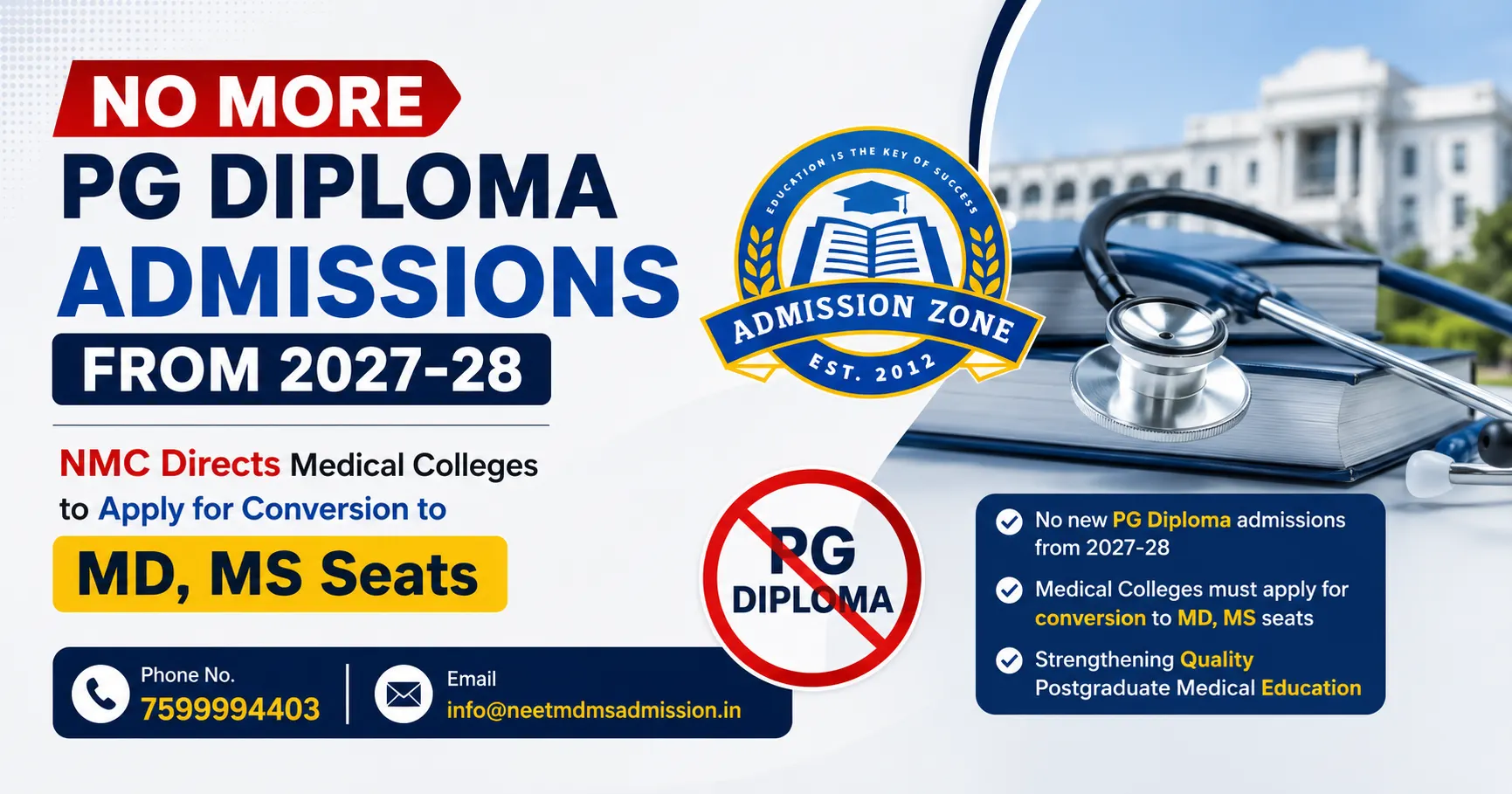
Through a public notice dated 19 June 2026, the National Medical Commission (NMC) has announced that Academic Year 2026-27 will be the last year of admission to PG Diploma courses. From 2027-28, no PG Diploma admissions will be allowed. Medical colleges must apply to the Medical Assessment and Rating Board (MARB) to convert their diploma seats into MD/MS degree seats.
NEET PG 2026 Rank Predictor: Check Your Diploma and MD/MS Seat Chances
Select Your Category
Enter Your NEET PG Score
Almost There!
NMC PG Diploma Notice 2026: Key Highlights
| Particulars | Details |
|---|---|
| Issued by | National Medical Commission (NMC) – Postgraduate Medical Education Board (PGMEB) |
| Notice date | 19 June 2026 (PGMEB public notice); communicated to colleges on 22 June 2026 |
| Regulation | Footnote to Regulation 2.1, PGMER 2023 |
| Last year of PG Diploma admission | Academic Year 2026-27 |
| PG Diploma admissions stop from | Academic Year 2027-28 |
| Last admission route for diploma seats | NEET PG 2026 counselling (MCC AIQ and state quota), academic year 2026-27 |
| Applies to | All PG Diploma courses in all medical colleges |
| Conversion into | MD / MS (broad speciality degree) seats |
| Where colleges apply | Medical Assessment and Rating Board (MARB), online portal |
| Detailed timelines | To be released separately by MARB |
What Does the NMC Notice Say?
According to the PGMEB notice, “The Academic Year 2026-27 shall be the last academic year for admission to Post Graduate Diploma courses. No admissions shall be permitted to PG Diploma courses from Academic Year 2027-28 onwards.”
Colleges that currently run PG Diploma courses can apply to convert these seats into matching MD or MS seats. The application must be made to MARB through a dedicated online portal, and approval will depend on the college meeting NMC standards for faculty, infrastructure and clinical material.
Why Is NMC Ending PG Diploma Courses?
NMC has said the move is meant to standardise postgraduate medical education and make better use of the capacity colleges already have. The main reasons are:
- One uniform standard: a 3-year MD/MS degree instead of a mix of 2-year diplomas and 3-year degrees.
- Better use of resources: departments that already have faculty and patients for diploma training can run degree courses instead.
- Clearer career path: diploma holders often faced limits in teaching posts and super-speciality eligibility.
- More specialists: converting diploma seats adds degree-trained specialists to the health system.
Which PG Diploma Courses Are Affected?
The notice applies to all PG Diploma courses. The most common diploma courses and the MD/MS degree they would normally convert into are listed below:
| PG Diploma Course | Likely MD/MS Conversion |
|---|---|
| DCH (Diploma in Child Health) | MD Paediatrics |
| DGO (Diploma in Obstetrics & Gynaecology) | MS Obstetrics & Gynaecology |
| DA (Diploma in Anaesthesiology) | MD Anaesthesiology |
| DMRD (Diploma in Medical Radio-Diagnosis) | MD Radiodiagnosis |
| DO / DOMS (Diploma in Ophthalmology) | MS Ophthalmology |
| DLO (Diploma in Otorhinolaryngology) | MS ENT |
| D.Ortho (Diploma in Orthopaedics) | MS Orthopaedics |
| DPM (Diploma in Psychological Medicine) | MD Psychiatry |
| DDVL (Diploma in Dermatology, Venereology & Leprosy) | MD Dermatology, Venereology & Leprosy |
| DCP (Diploma in Clinical Pathology) | MD Pathology |
| TDD (Diploma in Tuberculosis & Chest Diseases) | MD Respiratory Medicine |
Note: The final list of converted seats will depend on MARB approvals for each college.
How Will Colleges Convert Diploma Seats into MD/MS Seats?
- The college checks that the department meets NMC norms for faculty, beds, clinical load and infrastructure for an MD/MS course.
- The college applies to MARB through the dedicated online portal.
- MARB assesses the application as per NMC standards.
- If approved, the diploma seats are added to the college as MD/MS seats for the 2027-28 session.
- Diploma seats that are not converted will lapse, because no diploma admission is allowed from 2027-28.
PG Diploma vs MD/MS: What Changes for Students?
| Feature | PG Diploma (till 2026-27) | MD / MS Degree |
|---|---|---|
| Duration | 2 years | 3 years |
| Thesis | Not required | Required |
| Teaching eligibility | Limited | Eligible for faculty posts |
| Super-speciality (DM/MCh) | Not directly eligible | Eligible through NEET SS |
| Admissions after 2027-28 | Closed | Continue through NEET PG |
For a full guide to degree courses, see MD courses after MBBS and best MD/MS/DNB specialization after MBBS.
Impact on NEET PG Aspirants
NEET PG 2026 Candidates (Last Diploma Batch)
- NEET PG 2026 counselling is the last chance to get a PG Diploma seat.
- If you are considering a diploma seat as a backup, this is the final year it will be available.
- Students already enrolled in a diploma course are not affected, since the notice stops only fresh admissions.
NEET PG 2027 and Later Candidates
- The MCC and state seat matrices will have no PG Diploma seats.
- Choice filling will only include MD, MS and DNB seats.
- Branch-wise cut-offs may shift where diploma seats are converted. Track the NEET PG seat matrix each year.
- Candidates who earlier relied on diploma seats at lower ranks may need to reconsider DNB or other options.
Existing Diploma Holders
Doctors who already hold a PG Diploma can still upgrade to a degree-equivalent qualification through the NBEMS post-diploma DNB route. Read our guide to the DNB PDCET exam for post-diploma admission.
Impact on Medical Colleges
- Colleges must meet MD/MS faculty and infrastructure norms to convert seats.
- Colleges that cannot meet the norms will lose their diploma seats from 2027-28.
- Faculty and clinical upgrades may be needed in departments such as Anaesthesiology, Paediatrics, Obstetrics & Gynaecology and Radiology.
What Should NEET PG 2026 Candidates Do Now?
Because 2026-27 is the final diploma admission cycle, candidates who may land in the diploma rank range should plan their choices before counselling rounds begin:
- Decide early whether a PG Diploma seat is acceptable to you, since no diploma seat will be offered again from 2027-28.
- Compare diploma, MD/MS and DNB options at your expected rank using the rank predictor above before filling choices.
- Prefer the degree course in the same branch (for example MD Paediatrics over DCH) if your rank allows, as it offers thesis-based training, faculty eligibility and a NEET SS pathway.
- If you take a diploma seat, note that the post-diploma DNB route remains the way to upgrade to a degree-equivalent qualification later.
- Follow only official sources (nmc.org.in, mcc.nic.in and your state counselling website) for MARB timelines and final seat lists.

Frequently Asked Questions (FAQs)
Yes. As per the NMC PGMEB notice of June 2026, Academic Year 2026-27 is the last year for admission to PG Diploma courses. No new PG Diploma admissions will be allowed from Academic Year 2027-28 onwards.
Yes. NEET PG 2026 counselling (academic year 2026-27) is the last admission cycle in which PG Diploma seats such as DCH, DGO, DA or DMRD can be allotted.
Colleges must apply to the Medical Assessment and Rating Board (MARB) through its dedicated online portal. Conversion is approved only if the college meets NMC norms for faculty, infrastructure and clinical material. MARB will issue the detailed process and timelines separately.
The notice stops fresh admissions only. It does not cancel ongoing diploma courses, so students already admitted are expected to complete their programme and receive their diploma as usual.
MD/MS seats are likely to increase in NEET PG 2027 counselling, but only for colleges whose conversion is approved by MARB. Diploma seats that are not converted will simply lapse.
From NEET PG 2027, the MCC and state seat matrices will have no PG Diploma seats. Candidates will choose only from MD, MS and DNB seats, so choice filling and branch-wise cut-offs may shift.
The PGMEB public notice is dated 19 June 2026, and NMC communicated the direction to medical colleges on 22 June 2026. It was issued under the footnote to Regulation 2.1 of PGMER 2023.
All PG Diploma courses are covered, including DCH, DGO, DA, DMRD, DO/DOMS, DLO, D.Ortho, DPM, DDVL, DCP and TDD. Each can be converted into the matching MD/MS broad speciality, subject to MARB approval for each college.
Connect with Us
Start your medical educational journey with the Admission Zone! Contact us today at 9205488482/7599994403 or WhatsApp us to explore a world of educational possibilities in the state and secure your admission to a brighter future.
Conclusion
NMC has made 2026-27 the last year of PG Diploma admissions, and from 2027-28 only MD/MS degree seats will be offered in these specialities. For NEET PG 2026 candidates, this is the final chance at a diploma seat. For NEET PG 2027 aspirants, the seat matrix will look different, with more degree seats wherever MARB approves conversion. Always verify seat and counselling details on the official NMC, MCC and state counselling websites.
Source: NMC Postgraduate Medical Education Board public notice, June 2026 (PGMER 2023, Regulation 2.1). For more updates, read NEET PG 2026 latest news.