

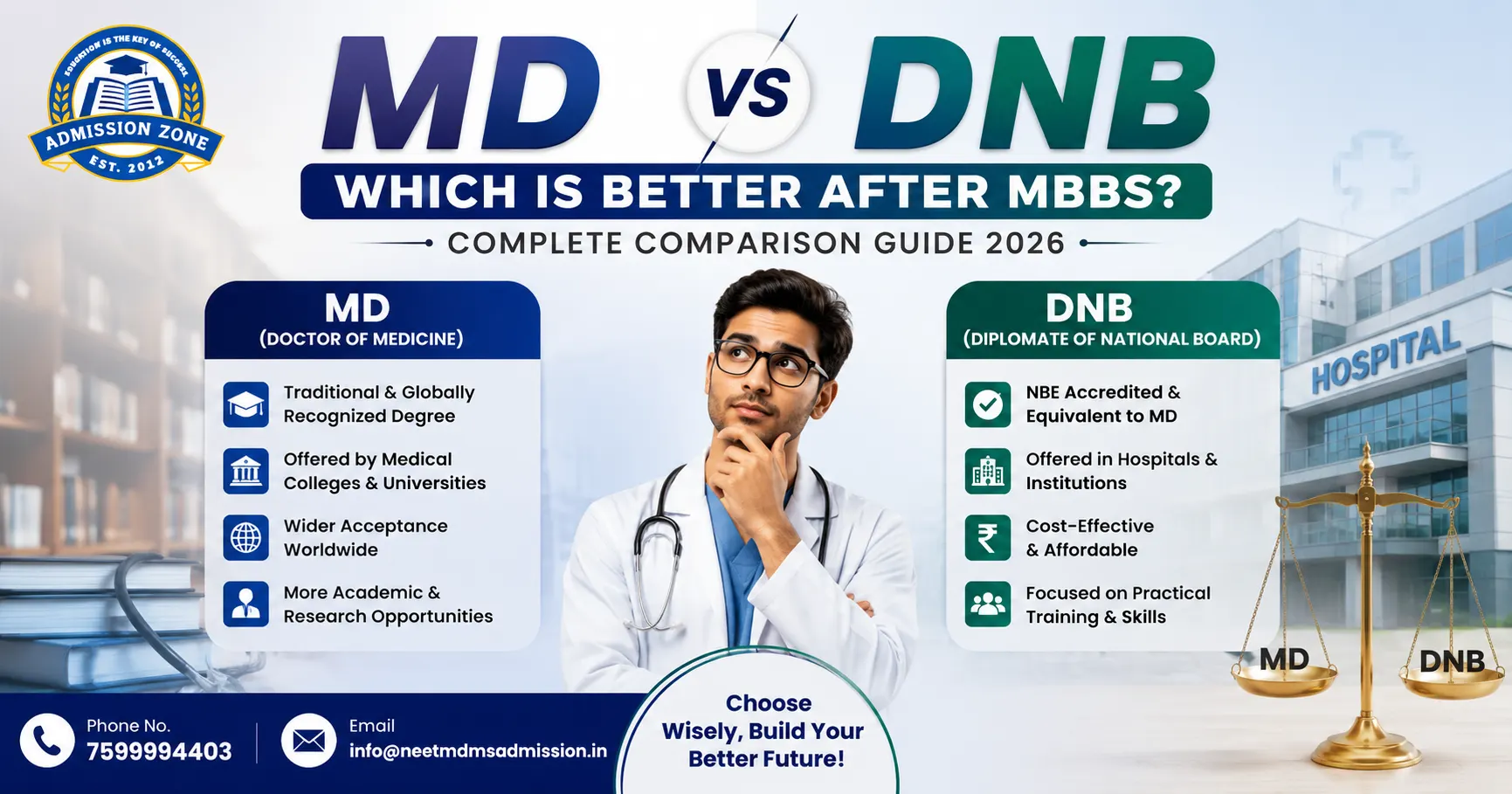
Choosing a postgraduate medical course after MBBS is one of the most important career decisions for aspiring doctors. Every year, thousands of medical graduates appear for NEET PG and face a common question: MD or DNB which is better?
Both MD (Doctor of Medicine) and DNB (Diplomate of National Board) are highly respected postgraduate qualifications recognised in India. While both lead to specialist careers, they differ in training environment, seat availability, hospital exposure and academic structure.
This comprehensive 2026 guide explains the differences between MD vs DNB, eligibility requirements, admission process, career opportunities, fees, recognition and helps you identify the best PG course after MBBS based on your career goals.
Understanding the Three Postgraduate Pathways
After completing MBBS medical graduates can start three major postgraduate pathways:
- MD (Doctor of Medicine) – Non-surgical specialities
- MS (Master of Surgery) – Surgical specialities
- DNB (Diplomate of National Board) – Equivalent postgraduate specialisation provided through accredited hospitals
All three qualifications are recognised by the National Medical Commission (NMC) and can lead to successful specialist careers.
What Is MD (Doctor of Medicine)?
MD is a postgraduate medical degree awarded by universities and medical colleges. It focuses on the diagnosis, treatment and prevention of diseases in non-surgical specialities.
The course duration is generally 3 years after MBBS, and admission is based on NEET PG ranks and counselling.
MD programs are provided by government medical colleges, private medical colleges, deemed universities and central institutes.
Common MD Branches Include:
Many students search for MD Branches after MBBS before selecting their preferred speciality.
Popular MD branches include:
- MD General Medicine
- MD Pediatrics
- MD Radiodiagnosis
- MD Dermatology
- MD Psychiatry
- MD Anaesthesiology
- MD Pathology
- MD Pharmacology
- MD Microbiology
- MD Community Medicine
- MD Respiratory Medicine
- MD Emergency Medicine
- MD Nuclear Medicine
What Is MS (Master of Surgery)
MS is a postgraduate degree focused on surgical disciplines.
Popular MS specialties include:
- MS General Surgery
- MS Orthopaedics
- MS ENT
- MS Ophthalmology
- MS Obstetrics & Gynaecology
Students interested in operative procedures and surgical careers generally choose MS programs.
What Is DNB (Diplomate of National Board)
DNB is a postgraduate qualification awarded by the National Board of Examinations in Medical Sciences (NBEMS).
The program is conducted in accredited hospitals rather than traditional medical colleges.
DNB offers training in both medical and surgical specialties and is considered equivalent to MD/MS under current regulations.
DNB programs are available in:
- Corporate Hospitals
- Government Hospitals
- Trust Hospitals
- Specialized Institutes
Many reputed hospitals across India offer DNB training with extensive clinical exposure.
Is DNB Really Equivalent to MD/MS?
Yes, according to current NMC and NBEMS regulations, DNB qualifications are recognised as equivalent to MD/MS qualifications for most academic, employment and professional purposes.
Doctors holding DNB degrees can:
- Practice as specialists
- Apply for government jobs.
- Join private hospitals
- Pursue super-speciality courses (DM/MCh/DNB SS)
- Work in teaching positions as per the prevailing NMC norms.
Therefore, from a recognition perspective, the MD vs DNB debate is not about validity but about training environments and career preferences.
Eligibility and Admission: A Single Gateway
Admission to MD, MS, and DNB courses follows a common process.
| Criteria | Requirement |
|---|---|
| Qualification | MBBS Degree |
| Internship | Mandatory completion before prescribed date |
| Registration | NMC/State Medical Council Registration |
| Entrance Exam | NEET PG |
| Nationality | Indian/Eligible Foreign Candidates |
DNB Entrance Exam
Many students search for the DNB entrance exam separately.
As of 2026, admission to DNB broad speciality courses is primarily through NEET PG, followed by centralised counselling.
There is no separate entrance examination for DNB broad speciality admission. Candidates qualify through NEET PG and participate in counselling conducted by MCC or relevant authorities.
MD v/s DNB: Admission Process
The admission pathway is largely similar for both courses.
Step-by-Step Admission Process
- Complete MBBS
- Finish compulsory internship
- Appear for NEET PG
- Obtain a qualifying percentile
- Participate in counselling
- Choose MD, MS, and DNB seats.
- Seat allotment
- Document verification
- Reporting and admission
Expected Admission Timeline 2026
| Event | Tentative Timeline 2026 |
|---|---|
| NEET PG Notification | January–February 2026 |
| Application Process | February–March 2026 |
| NEET PG Examination | June–July 2026 |
| Result Declaration | July 2026 |
| Counselling Registration | August 2026 |
| Round 1 Counselling | August–September 2026 |
| Round 2 Counselling | September 2026 |
| Mop-Up Round | October 2026 |
| Stray Vacancy Round | October–November 2026 |
MD vs MS vs DNB: Side-by-Side Comparison
| Feature | MD | MS | DNB |
|---|---|---|---|
| Full Form | Doctor of Medicine | Master of Surgery | Diplomate of National Board |
| Focus | Medical Specialties | Surgical Specialties | Medical & Surgical Specialties |
| Duration | 3 Years | 3 Years | 3 Years |
| Admission | NEET PG | NEET PG | NEET PG |
| Training Location | Medical Colleges | Medical Colleges | Accredited Hospitals |
| Degree Awarding Body | University | University | NBEMS |
| Recognition | NMC Recognized | NMC Recognized | NMC Recognized |
| Clinical Exposure | High | High | Often Very High |
| Research Requirement | Mandatory | Mandatory | Varies by Institution |
| Teaching Opportunities | Available | Available | Available |
MD vs DNB: Fees Comparison
The fee structure varies significantly.
| Course Type | Approximate Annual Fees |
|---|---|
| Government MD/MS | ₹20,000 – ₹2 Lakhs |
| Private MD/MS | ₹5 Lakhs – ₹40 Lakhs+ |
| DNB Government Hospitals | Often Stipend-Based |
| DNB Private Hospitals | ₹50,000 – ₹5 Lakhs |
MD vs DNB: Cutoff Trends
Cutoffs depend on:
- Specialty chosen
- Category
- Seat availability
- Institution reputation
- Competition level
Highly competitive branches include:
- Radiology
- Dermatology
- General Medicine
- Pediatrics
- Orthopaedics
- Obstetrics & Gynaecology
Generally, top government MD seats require higher NEET PG ranks than many DNB seats, though premier DNB institutions can also have highly competitive cutoffs.
MD V/s DNB: Career Opportunities and Recognition
Both qualifications provide career growth.
Career Options After MD
- Specialist Consultant
- Senior Resident
- Medical College Faculty
- Researcher
- Public Health Expert
- Hospital Administrator
Career Options After DNB
- Consultant Specialist
- Corporate Hospital Specialist
- Government Sector Specialist
- Academic Faculty
- Super-Speciality Aspirant
- Clinical Research Professional
Higher Studies After MD or DNB
Candidates can pursue:
- DM (Doctor of Medicine)
- MCh (Master of Chirurgiae)
- DNB Super Speciality
- Fellowships
- International Certifications
MD or DNB: Which is Better?
There is no universal answer.
The better option depends on individual career goals.
Choose MD If:
- You prefer a traditional medical college environment.
- You are interested in academic medicine.
- You want structured university-based training.
- You aim for careers in teaching and research.
Choose DNB If:
- You want exposure in high-volume hospitals.
- You prefer advanced corporate healthcare settings.
- You are unable to secure your preferred MD seat but obtain a strong DNB institution.
- You value extensive clinical exposure.
In many cases, a DNB from a reputable hospital can provide training comparable to, or even better than, some MD programs.
Which Is the Best PG Course After MBBS?
The best PG course after MBBS depends on your interests, aptitude, and career plans.
Popular choices include:
Clinical Branches
- MD General Medicine
- MD Pediatrics
- MD Radiodiagnosis
- MD Dermatology
- MS General Surgery
- MS Orthopaedics
Non-Clinical Branches
- MD Pathology
- MD Pharmacology
- MD Microbiology
Emerging High-Demand Specialities
- Emergency Medicine
- Critical Care
- Nuclear Medicine
- Community Medicine
- Hospital Administration
Instead of focusing solely on degree titles, students should evaluate:
- Personal interest
- Lifestyle goals
- Future demand
- Research opportunities
- Earning potential
- Work-life balance
Key Factors to Consider Before Choosing MD or DNB
Before finalising your seat, evaluate:
- Institution reputation
- Faculty quality
- Patient load
- Clinical exposure
- Research opportunities
- Infrastructure
- Pass percentage
- Alumni outcomes
- Future super-speciality prospects
The quality of training often matters more than the degree title itself.

Frequently Asked Questions (FAQs)
Ans- Yes. DNB is recognised by NMC and is considered equivalent to MD/MS for most professional, academic, and employment purposes.
Ans- Yes. DNB graduates are eligible to appear for super-speciality entrance examinations and pursue DM, MCh or DNB Super Speciality courses.
Ans- Both have career prospects. The scope depends more on the speciality chosen and the quality of the training institution.
Ans- MD PSM stands for Doctor of Medicine in Preventive and Social Medicine, commonly known as Community Medicine.
Ans- For broad speciality admissions, candidates generally gain admission through NEET PG followed by counselling.
Ans- Radiology, Dermatology, General Medicine, Pediatrics, Orthopaedics and Emergency Medicine remain among the most sought-after specialities.
Ans- In some specialities and institutions, DNB seats may have comparatively lower cutoff ranks. Also, competition for top DNB hospitals can be equally intense.
Connect with Us
Start your medical educational journey with the Admission Zone! Contact us today on 9205488482/ 7599994403 or WhatsApp us to explore a world of educational possibilities in the state and secure your admission to a brighter future.
Conclusion
The debate around MD vs DNB continues among medical aspirants, but both qualifications offer recognised pathways to becoming a specialist doctor. The real deciding factors should be your career goals, preferred speciality, clinical training, academic interests and the quality of the institution.
When evaluating MD or DNB programs, focus on training quality rather than just the degree name. An MD program and a reputed DNB institution can both lead to excellent professional growth.
For NEET PG aspirants in 2026, careful analysis of counselling options, branch preferences, cutoff trends and long-term career objectives will help them choose the best PG course after MBBS and build a successful medical career.